
A Client's Question That Most People Never Think to Ask
My client Maggie (a pseudonym) had been steadily adding hip and core work to her program.
Standing Lateral Presses against a resistance band, her core braced, resisting the pull toward the attachment point.
A movement I call the Golfer's Pickup: standing on one leg, hinging forward at the hip while keeping a straight line from shoulder to ankle on the moving leg (targeting the glute and hamstring of the standing leg).
Hip Burners, a more targeted progression of the classic clamshell exercise, aimed at fatiguing the outer hip as efficiently as possible.
She was feeling the work.
Her balance was improving.
Her form on sit-to-stand had visibly cleaned up.
Then she asked the question that gets to the heart of a very common misunderstanding:
“Is Load Tolerance dependent on building muscle to support my knee joint?”
It's a fair assumption.
Most conventional advice treats "strengthen the muscles around the joint" as the whole answer to knee pain.
But the honest answer is more specific than that, and understanding it changes how you should think about your own progress.
The Mechanism: Two Systems, Not One
Muscle strength and Knee Joint Strength are measured differently, adapt on different timelines, and solve different problems.
Your glutes and core don't touch your cartilage directly.
What they do is control alignment.
When your hip is stable, your femur (the thigh bone that forms the groove your kneecap rides in) holds a better position during a squat, a step, or a sit-to-stand.
That better alignment can reduce certain forces on sensitive structures like the patellofemoral joint (behind your kneecap).
That's a genuinely useful effect.
It's also not the same as building the joint's actual capacity to absorb load.
Research comparing core stability training to hip strengthening in adults with knee osteoarthritis found both approaches produced statistically significant improvements in knee pain, muscle strength, and function.
That's a real, measurable benefit.
But the outcome being measured was symptoms and function, not the internal capacity of the joint's cartilage to tolerate load.
That distinction matters because a separate line of research following 265 knee osteoarthritis patients over 30 months found that greater quadriceps strength had no protective effect on cartilage loss at the joint itself, even though those same patients reported less pain.
Sometimes stronger muscles, including stronger core and hip muscles, can make you feel better and move with better form.
They don't, by themselves, tell you whether your knee joint is ready for more activity and more load.
Why the Inside Out Knee Health Framework Trains Both, In Sequence
This is exactly why glute and core work has a defined role in the Inside Out Knee Health approach, rather than being treated as the end goal.
Phase 1 improves the internal joint environment.
Isometric exercises and gentle motion support synovial fluid quality and calm irritation, so the knee joint has a baseline to build from.
Phase 2 builds actual Squat Load Tolerance often using the Variable Incline Plane (VIP), which measures the precise, pain-free percentage of bodyweight a knee can handle during a squat.
This is the phase most generic physical therapy and fitness programs skip.
Because it requires direct measurement, beyond a basic exercise list.
Phase 3 strengthens the external structures, including the glutes and core, and rebuilds toward the loads that a real, active life requires.
Glute and core exercises support Phase 3 well.
They give the joint a more stable environment to work within, and they help translate improved Load Tolerance into real-world movement.
What they don't do is replace the measured, progressive loading that happens in Phase 2.
What This Looks Like in Practice
In Maggie's program, the hip and core exercises were introduced deliberately, in a specific order, for a specific reason.
Log Rolls and Hip Burners came first, waking up the core and outer hip so that alignment would hold during more demanding movements.
Closed-chain work, like the Standing Lateral Press, came next.
The Golfer's Pickup was added once balance and hip control were solid.
Because it asks the standing leg's glute and hamstring to control a longer lever arm.
These begin adding measured, subtle load through the knee while the glute and core provide alignment support during the movement.
None of these exercises were prescribed to build Squat Load Tolerance directly.
Their job was to support better alignment, so that the progressive joint loading work happening separately could proceed without unnecessary compensation patterns getting in the way.
Mistakes People Make With Glute and Core Work
Mistake 1: Assuming Glute Strength Is the Whole Fix
If glute and core exercises reduce pain, it's tempting to conclude the joint itself has gotten stronger. Often what's improved is alignment and control, which matters, but is a different achievement than an increase in the knee joint's actual capacity to absorb load. Pain relief and Load Tolerance can move independently of each other, at least at first.
Mistake 2: Skipping Squats Because "My Muscles Feel Weak"
Some people interpret quad or glute fatigue during a squat as a sign the joint itself isn't ready, and back off the very loading work that would build Load Tolerance. Muscle fatigue and joint readiness are separate signals. The trait that matters for progress is whether knee symptoms stay within the normal adaptation window afterward, not whether the muscles felt tired during the set.
Mistake 3: Treating All Closed-Chain Exercises as Interchangeable with VIP Training
Chair squats, standing presses, and similar closed-chain movements do add some load through the knee, and that's valuable. But without a way to measure the specific percentage of bodyweight the joint is absorbing, and without a device like the VIP that isolates the load a single knee is bearing, it’s difficult to know whether that load is calibrated to what the joint can currently tolerate, or whether it's overshooting.
The Reframing Insight
Here's the part that gets missed:
Glute and core work isn't a lesser version of joint training, and it isn't wasted effort either.
It's a different job entirely.
A stable hip gives a vulnerable knee better support.
That has merit.
The muscles around your knee can do excellent work.
But a stable hip sitting on top of a knee joint that hasn't been progressively loaded is still a joint that hasn't built its capacity.
The question that actually determines your progress is a separate one:
Is the load you're asking your knee to absorb matched to what it can currently handle?
That's not a question your glutes can answer.
It's one only direct, progressive loading of the joint itself can answer.
Frequently Asked Questions (FAQs)
Can strengthening my glutes fix my knee pain?
It can meaningfully reduce symptoms. Research comparing core stability to hip strengthening in knee osteoarthritis patients found both produced significant improvements in pain and function. But symptom improvement through better alignment is a different outcome than an increase in the knee joint's capacity, which requires separate, progressive loading.
What's the actual difference between muscle strength and Knee Joint Strength?
Muscle strength determines whether you can perform a movement with good form. Knee Joint Strength determines whether your knee can absorb that movement without causing pain, stiffness, or swelling. They're assessed differently and improve on different timelines, with muscle typically adapting faster than joint tissue.
If glute work doesn't build Load Tolerance, why is it part of the program at all?
Because it solves a real problem: alignment. A stable hip keeps the femur, and therefore the kneecap's tracking groove, in a better position during loaded movement. That reduces unnecessary forces on sensitive structures and gives the joint a more favorable environment while Squat Load Tolerance is being built separately.
Is there research specifically on hip or core strengthening for knee osteoarthritis?
Yes. A randomized controlled trial comparing core stability exercises to hip strengthening exercises in adults with knee osteoarthritis found both groups improved significantly in pain, strength, and functional outcomes, with no meaningful difference between the two approaches.
How do I know if my glutes or my joint's Load Tolerance is the limiting factor?
If you have good alignment and control during a movement but still develop delayed symptoms afterward, that points toward Load Tolerance rather than muscle weakness. The Variable Incline Plane (VIP) is designed to measure that directly, rather than leaving it to guesswork.
Can I build Squat Load Tolerance without doing any glute or core work?
Not efficiently. Without adequate hip and core control, compensation patterns during loaded movement can introduce unnecessary forces on sensitive structures, which can slow progress or trigger irritation. The two types of training work best together.
What is Squat Load Tolerance and how is it different from what glute exercises build?
Squat Load Tolerance is the percentage of bodyweight your knee can accept during a squatting movement without producing pain, stiffness, or swelling. It's a direct measure of the joint's internal capacity. Glute and core strength affect the alignment and forces around that capacity, but they are not the same measurement, and improving one does not automatically improve the other.
Related Articles
The Difference Between Muscle Strength and Knee Joint Strength
Can You Actually Build Cartilage Strength? What the Research Says
What Is Load Tolerance? The Missing Link in Solving Knee Pain
The Inside Out Knee Health Approach: A Smarter Way to Build Stronger Knees
Strong Glutes Won’t Fix Your Knee Arthritis (What to Do Instead)
Research References
Jadhav V, Palsule S. Effect of Core Versus Hip Strengthening on Knee Function in Adults With Knee Osteoarthritis: A Randomized Controlled Trial. Cureus. 2025 Jun 13;17(6):e85967. doi: 10.7759/cureus.85967. PMCID: PMC12256711.
Amin S, Baker K, Niu J, Clancy M, Goggins J, Guermazi A, Grigoryan M, Hunter DJ, Felson DT. Quadriceps strength and the risk of cartilage loss and symptom progression in knee osteoarthritis. Arthritis Rheum. 2009 Jan;60(1):189-98. doi: 10.1002/art.24182. PMID: 19116936; PMCID: PMC3653642.
Disclaimer: Disclaimer: The information in this blog post is for educational and informational purposes only and is not intended as medical advice. It should not be used to diagnose, treat, or prevent any health issue or disease without consulting with a qualified healthcare professional. The author of this blog and the website do not bear any responsibility for any actions taken based on the information provided in this blog.
Related Posts
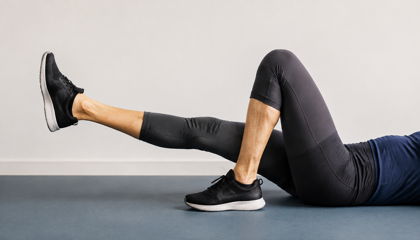
Strong Glutes Won't Fix Your Knee Arthritis (What to Do Instead)
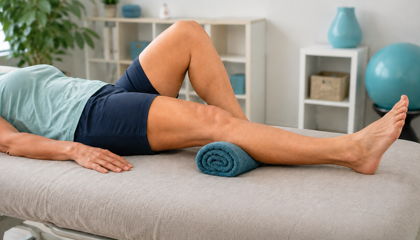
What Quad Sets Are Actually Doing For Your Knee
Quad sets don’t build strength by fatigue—they help calm irritation, improve quad activation, and prepare your knee for stronger loading.
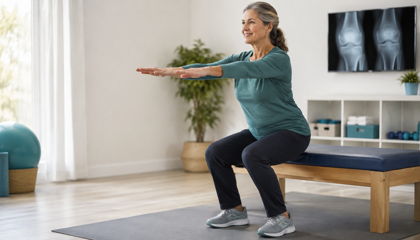
Why Your Orthopedist Said "Nothing Will Change" Your Knee
A knee X-ray can show arthritis, but it can’t explain all knee pain. Learn why pain and radiographic severity often don’t match—and what tissue may actually be involved.