When You're Doing Everything Right and Your Knee Still Hurts
If you have knee pain, you've probably already tried to fix it.
Maybe you've strengthened your quadriceps.
Stretched your hamstrings.
Iced after activity.
You may have tried a foam roller.
Maybe you've even had an injection.
And your knee pain keeps finding its way back.
Here's a pattern I hear constantly from clients.
They squat, walk, or bike and feel completely fine at that moment.
Then the next day, or two days later, their knee is stiff on the stairs or sore getting out of a chair.
This is delayed knee pain after exercise, and it isn't random.
It's not a sign that something is mysteriously wrong with your knee.
It's a sign the knee was asked to absorb more force than it could currently handle, and the consequences simply took a day or two to surface.
Most knee pain advice treats the knee like a hinge controlled entirely by the muscles around it.
Strengthen the quadriceps, strengthen the hips, and the knee should follow.
But a knee isn't only a hinge.
It's a joint with its own internal environment, and that environment has to be addressed before muscle strengthening can do its job.
That's the premise behind Inside Out Knee Health.
What's Actually Happening Inside an Irritated Knee
Two structures decide how your knee feels during and after activity: the synovial fluid that lubricates the joint, and the cartilage that fluid feeds.
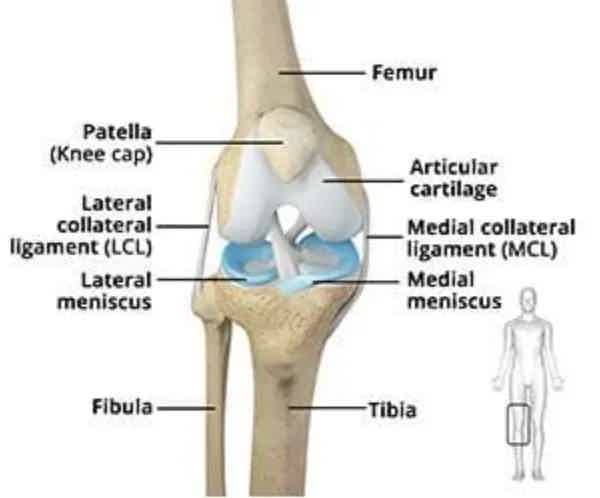
Synovial fluid reduces friction between cartilage surfaces and helps distribute force evenly across the joint.
When that fluid is thin or watery, cartilage experiences more shear with every step.
Here's the part most people are never told.
Cartilage itself has no nerve supply.
You cannot feel cartilage being irritated in real time the way you can feel a muscle getting tired.
What you can feel is the synovial membrane, the lining of the joint capsule, which does have nerve supply.
When cartilage surfaces are repeatedly overloaded, that irritation eventually reaches the synovial membrane.
That's when stiffness, swelling, or a deep ache shows up.
That delay between the overload and the symptom is exactly why knee pain so often shows up a day or two after activity instead of during it.
Knowing this changes the question worth asking.
It's not "what did I do wrong yesterday?"
It's "what is my knee's current capacity to absorb force, and did yesterday's activity exceed it?"
That capacity has a name: Load Tolerance.
It's the amount of force your knee can produce or absorb for a given movement without triggering pain, stiffness, or swelling in the hours and days that follow.
I often compare Load Tolerance to a bank account.
Every activity is either a deposit or a withdrawal.
Move within your current capacity, and your knee maintains its balance.
Push past it, like an aggressive hike or a Peloton class with more resistance than your knee has built up to, and you make a withdrawal your knee can't currently cover.
The "fee" for that overdraft is the soreness that shows up a day or two later.
Common daily tasks already require a substantial amount of Load Tolerance.
Sitting down on a couch, standing up from a desk chair, and getting out of a car each place roughly half your bodyweight through one knee.
If your Squat Load Tolerance is below that threshold, ordinary moments, not just workouts, can be where symptoms start.
For Inside Out Knee Health,
here's a guide to get started:
You can access it here.
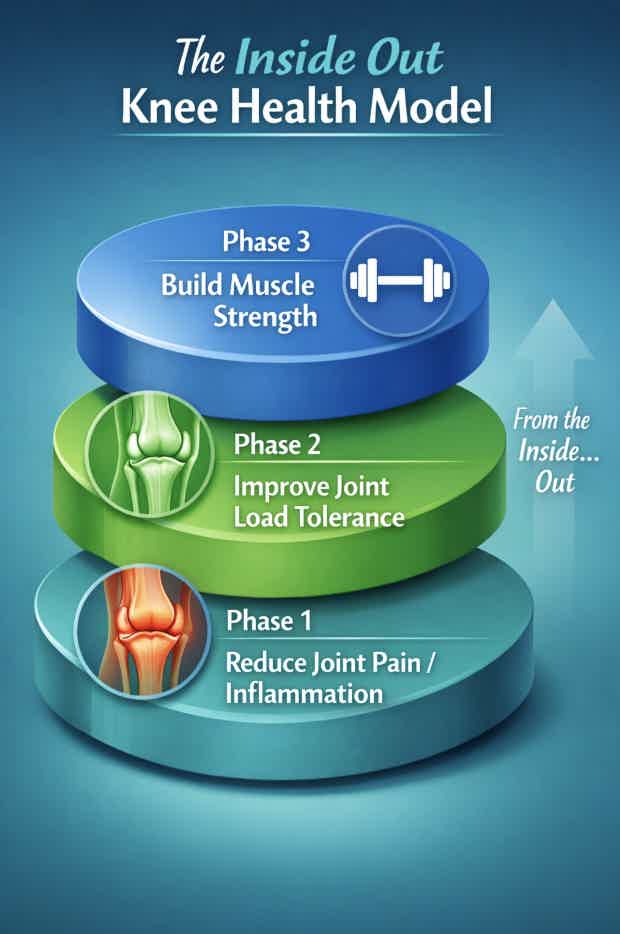
The Inside Out Knee Health Model
Building muscle strength on top of a knee that can't yet bear the load is like adding a second story to a house before the foundation has cured.
It might hold for a while, but the weight eventually finds the weak point.
This is why Inside Out Knee Health builds knees in a specific order, rather than jumping straight to muscle strengthening.
Phase 1: Improve the Internal Joint Environment
The first phase focuses on the quality of the synovial fluid and calming irritation inside the knee joint, before asking the knee to do anything more demanding.
A specific type of muscle activation, isometric quadriceps contraction performed without joint movement, has been shown to change the biochemistry of joint fluid itself.
In a study of patients with knee osteoarthritis, twelve weeks of isometric quadriceps exercise increased the molecular weight and viscosity of joint fluid while pain scores fell by 41% (1).
Hyaluronan molecular weight rose by roughly 14 percent and fluid viscosity climbed by about 30 percent, while a marker associated with cartilage breakdown decreased over the same period.
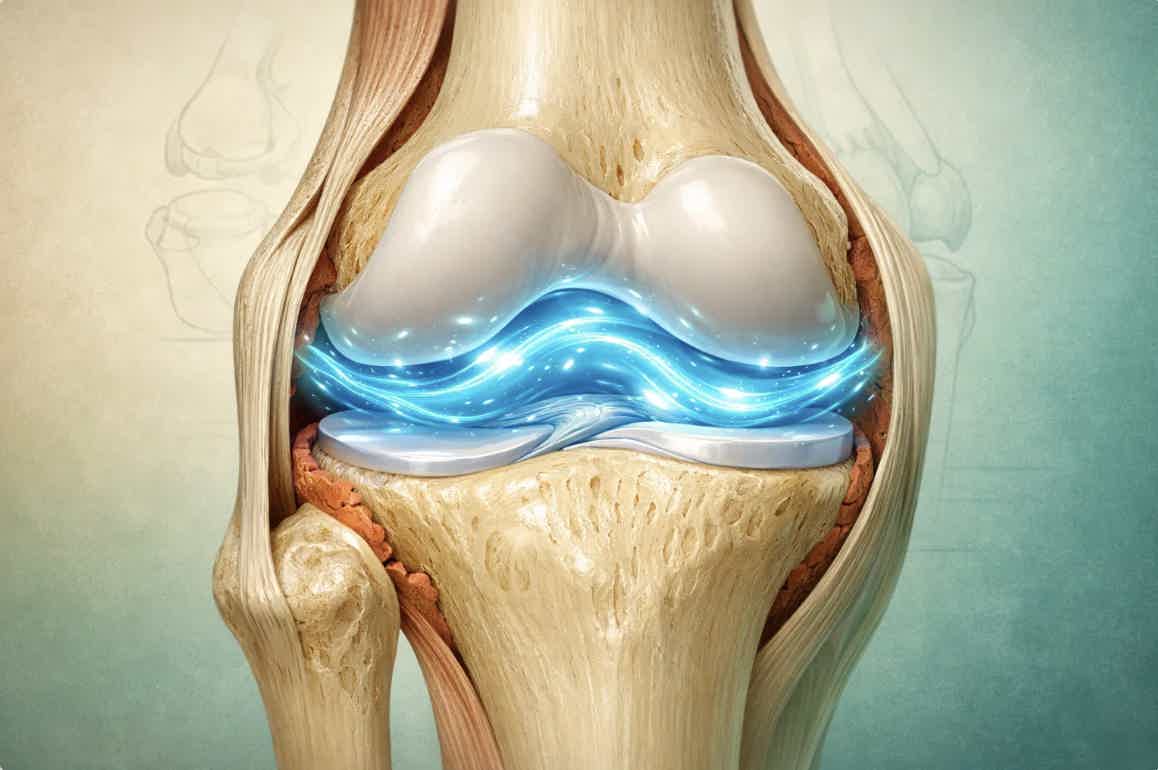
Synovial Fluid Dynamics: The glowing blue fluid represents healthy, viscous synovial fluid flowing smoothly between cartilage surfaces, providing optimal lubrication and shock absorption.
That's a meaningfully different mechanism than "getting stronger."
It's changing the lubrication system the knee depends on, before strengthening is even introduced.
Clients in this phase typically notice less morning stiffness and more predictable comfort with walking before they notice any change in muscle strength.
Phase 2: Build Knee Joint Load Tolerance
Cartilage has no blood supply of its own.
It receives nutrients almost entirely through the movement of synovial fluid in and out of the tissue during loading, a pumping mechanism researchers have documented since at least 1990 (2).
That means cartilage actually needs controlled loading to stay healthy.

Mechanotransduction at Work: Golden pathways represent cellular signals triggered by controlled mechanical loading, which strengthens the cartilage matrix and improves its resilience.
The goal of Phase 2 isn't to avoid load.
It's to find the Goldilocks zone: enough force to stimulate adaptation, not so much that it overwhelms the joint's current capacity.
This is where measurement matters more than guessing.
A Variable Incline Plane (VIP) allows a precise, gradual increase in squatting force, the same way measuring cups make a recipe repeatable instead of a guess.
Without that kind of measurement, most people either overload the joint by progressing too fast, or plateau by staying too conservative for too long.
There's encouraging evidence that this kind of joint resilience is more achievable than cartilage's reputation suggests.
A 2026 analysis of more than 1,400 osteoarthritic knees found that 14 percent showed spontaneous cartilage thickening over two years, not thinning (3).
The researchers were careful to note this was an observational finding, not the result of any specific intervention, and the mechanisms behind it remain unconfirmed.
Still, it pushes back on the assumption that cartilage only ever wears down.
H3: Phase 3: Strengthen the External Structures
Once the joint's internal environment is calmer and its Load Tolerance has improved, the program shift its primary focus to strengthening the quadriceps, hamstrings, hips, glutes, and core stabilization muscles.
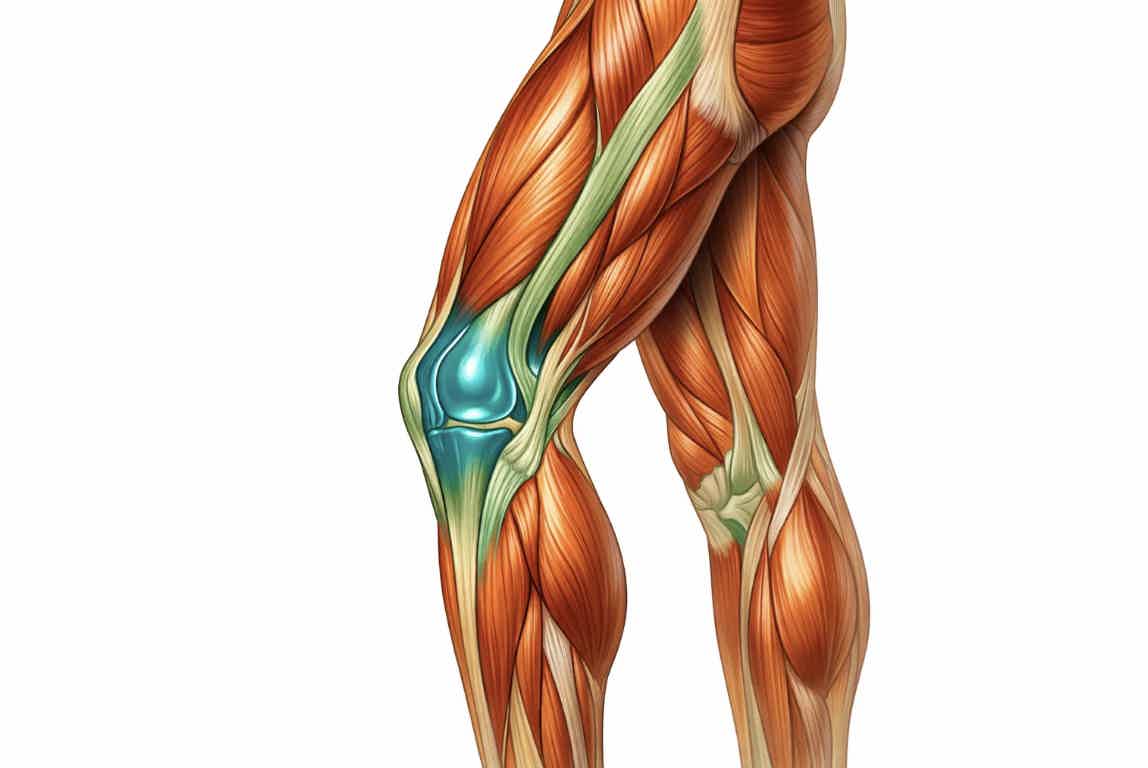
Muscular Support System: Strong, well-defined muscles (shown in warm tones) provide dynamic support around the resilient knee joint (glowing teal), creating a robust, long-term solution.
The type of strengthening matters here too.
A 2024 network meta-analysis comparing different muscle contraction methods found that isokinetic, isotonic, and isometric strengthening each produced meaningful but different improvements in pain and function (4).
Strengthening isn't one-size-fits-all, and it's far more effective once the joint underneath it can actually tolerate the work.
This is the phase that gets people back to hiking, pickleball, cycling, and the activities they started this process to protect.
Three Mistakes That Keep Knee Pain Coming Back
Mistake 1: Jumping to Strengthening Before the Joint Is Ready
Most exercise programs for knee pain start with strengthening, squats, lunges, leg presses, because muscle weakness is visible and easy to measure. But strengthening exercises load the joint substantially. If the cartilage and synovial fluid inside the knee can't yet tolerate that load, the muscles may get stronger while the knee gets more irritated. This is a common reason cycling can feel fine in physical therapy but flare a knee at home: the duration, resistance, or intensity exceeded the knee's current Load Tolerance, not because biking itself is harmful.
Mistake 2: Resting Instead of Reloading
When a knee flares, resting it usually does reduce symptoms temporarily. The problem is that rest lowers the load on the knee without increasing what the knee can handle going forward. Knees that cycle between flare and rest, without ever building Load Tolerance in between, often end up weaker over time, not stronger, because they're never given the right dose of controlled loading to adapt.
Mistake 3: Mistaking Pain Relief for Joint Health
Cortisone injections can meaningfully reduce pain and swelling, sometimes for weeks to a few months. But reducing inflammation isn't the same as increasing what the joint can tolerate. For someone whose knee only hurts after demanding workouts, not during daily life, the issue usually isn't excess inflammation that needs eliminating. It's that the inside of the knee isn't yet strong enough to withstand the forces of the workouts they want to do, and an injection doesn't change that capacity.
For Inside Out Knee Health,
here's a guide to get started:
You can access it here.
The Real Reason Knee Pain Keeps Coming Back
It's tempting to believe knee pain means that your muscles are too weak, or that your knee is simply wearing out with age.
Neither of these is usually the real explanation.
The real explanation is almost always a mismatch.
The force placed on the knee exceeds what its internal structures can currently absorb.
That mismatch can happen with too much activity.
It can just as easily happen with too little, since under-loaded knees lose capacity over time the same way under-loaded muscles do.
The goal is never to avoid load.
The goal is to apply the right types, intensities and duration of loads to improve your knee’s Load Tolerance.
Frequently Asked Questions About the Inside Out Knee Health Approach
What is the Inside Out Knee Health approach?
Inside Out Knee Health is a three-phase method for resolving knee pain that addresses the joint's internal environment before focusing on muscle strength. Phase 1 improves synovial fluid quality through targeted isometric exercise, which has been shown to measurably change joint fluid biochemistry (1). Phase 2 builds Load Tolerance through carefully progressed loading. Phase 3 strengthens the surrounding muscles. For more on how this differs from a typical strength program, see what Load Tolerance actually measures.
Why does my knee feel fine during exercise, then hurt a day or two later?
This happens because cartilage has no nerve supply, so overload inside the joint doesn't register immediately. The discomfort appears once that irritation reaches the synovial membrane, which does have nerve supply, and that signal often arrives a day or two after the activity. Read more about why this delay happens and what it means for your training.
Is strengthening my quadriceps enough to fix knee pain?
Strengthening helps, but a 2024 network meta-analysis of 41 trials found that strengthening outcomes vary significantly depending on the type of muscle contraction used (4), and none of those approaches account for whether the joint itself can tolerate the load. Muscle strength and knee joint Load Tolerance are not the same thing.
Should I just rest my knee until it stops hurting?
Rest can calm an acute flare, but it doesn't build capacity. Rest lowers the load on your knee without increasing what your knee can handle afterward, which is why symptoms often return as soon as activity resumes.
Can knee cartilage actually get stronger, or does it only wear down with age?
Cartilage can't repair itself the way muscle does. However, because cartilage receives nutrients from synovial fluid movement, it does adapt to appropriate loading (2). A 2026 study even found that 14 percent of osteoarthritic knees showed spontaneous cartilage thickening over two years (3), though this was observational and the mechanism isn't yet confirmed.
Are cortisone or other injections a good long-term strategy for knee pain?
Injections can reduce pain and inflammation for a limited window, but they don't increase what the knee joint can tolerate going forward. For a fuller breakdown of the research on benefits and risks, see Before Your Next Knee Injection, Read This.
Related Articles
Why Knee Pain Shows Up After Exercise (even when it feels fine at the time)
What Is Load Tolerance? The Missing Link in Solving Knee Pain
Is Biking Good for Knee Pain? Why Peloton May Aggravate Your Knee — And How to Fix It
Research References
Miyaguchi M, Kobayashi A, Kadoya Y, Ohashi H, Yamano Y, Takaoka K. Biochemical change in joint fluid after isometric quadriceps exercise for patients with osteoarthritis of the knee. Osteoarthritis Cartilage. 2003 Apr;11(4):252-9. doi: 10.1016/s1063-4584(02)00372-2. Erratum in: Osteoarthritis Cartilage. 2003 Jul;11(7):548. PMID: 12681951.
O'Hara BP, Urban JP, Maroudas A. Influence of cyclic loading on the nutrition of articular cartilage. Ann Rheum Dis. 1990 Jul;49(7):536-9. doi: 10.1136/ard.49.7.536. PMID: 2383080; PMCID: PMC1004145.
C. Salzlechner, W. Wirth, S.C. Mastbergen, M. Kloppenburg, F.J. Blanco, I.K. Haugen, F. Berenbaum, M.P. Jansen, Does spontaneous cartilage thickening occur in osteoarthritic knees? Data from IMI APPROACH and the OAI, Osteoarthritis and Cartilage, Volume 34, Issue 4, 2026, Pages 601-606, ISSN 1063-4584,
Ding X, Yang Y, Xing Y, Jia Q, Liu Q, Zhang J. Efficacy of lower limb strengthening exercises based on different muscle contraction characteristics for knee osteoarthritis: a systematic review and network meta-analysis. Front Med (Lausanne). 2024 Sep 25;11:1442683. doi: 10.3389/fmed.2024.1442683. PMID: 39386751; PMCID: PMC11461219.
For Inside Out Knee Health,
here's a guide to get started:
You can access it here.
For personalized guidance to build Better Knees:
Schedule a free 20-minute Strategy Session. (Find your best time here.)
Disclaimer: Disclaimer: The information in this blog post is for educational and informational purposes only and is not intended as medical advice. It should not be used to diagnose, treat, or prevent any health issue or disease without consulting with a qualified healthcare professional. The author of this blog and the website do not bear any responsibility for any actions taken based on the information provided in this blog.
Related Posts

Why Muscle Strengthening Helps Some Knees and Hurts Others
Strengthening helps some knees and irritates others because the key factor is load tolerance—not effort, form, or willpower.

Why Taking the Uber Instead of Walking Might Be the Smartest Thing You Do for Your Knees
More walking isn’t always better for sore knees. Learn when taking the Uber, choosing the elevator, or pacing a trip can protect knee load tolerance.

Why Your Knee Feels Puffier Some Days Than Others (And How to Track It)
Some knee swelling isn’t random—it’s a delayed joint response. Learn why your knee looks puffier some days and how to track it with simple measurements.