
A Trip, a Knee Decision, and Two Very Different Futures
I saw Adria* following a weekend getaway with family.
The trip included things that gradually overloaded her knee:
a long walk through the airport with luggage,
a few hours standing at a concert, and
days spent navigating a city she didn't know well enough to find the shortest routes.
One evening, she suggested to a family member, who also deals with knee pain, that they take a rideshare to dinner instead of walking twenty minutes to the restaurant.
He said no. He always walks it.
He sees the walk as proof he's still active, still capable, still winning against the complaints of his knees.
Adria came home from a three-day trip with more knee soreness than she wanted.
The Mechanism: Why "More Walking" Doesn't Automatically Result in "Healthier Knees"
Your knee's ability to tolerate an activity without pain, stiffness, or swelling is called Load Tolerance.
This is the internal capacity of the joint itself, driven largely by the quality of your synovial fluid and the condition of your cartilage, not just the strength of the muscles around your knee.
Common daily demands, like walking, require a meaningful amount of that capacity.
Travel stacks several of these demands back to back, for hours, on unfamiliar surfaces, with less recovery time in between.
When the demand placed on the knee exceeds what the joint can currently tolerate, the joint responds.
Sometimes that response shows up immediately as pain.
Just as often, it shows up hours or a day later as stiffness, swelling, or a dull ache that seems to come from nowhere.
This delayed pattern is one reason people underestimate how much a single travel day actually costs their knees.
This is the same mechanism explored in Take the Stairs or the Elevator?, where the choice to use an elevator temporarily isn't about avoiding activity.
It's about matching the demand to the knee joint's current capacity while that capacity is being rebuilt.
The Inside Out Framework: Where This Fits
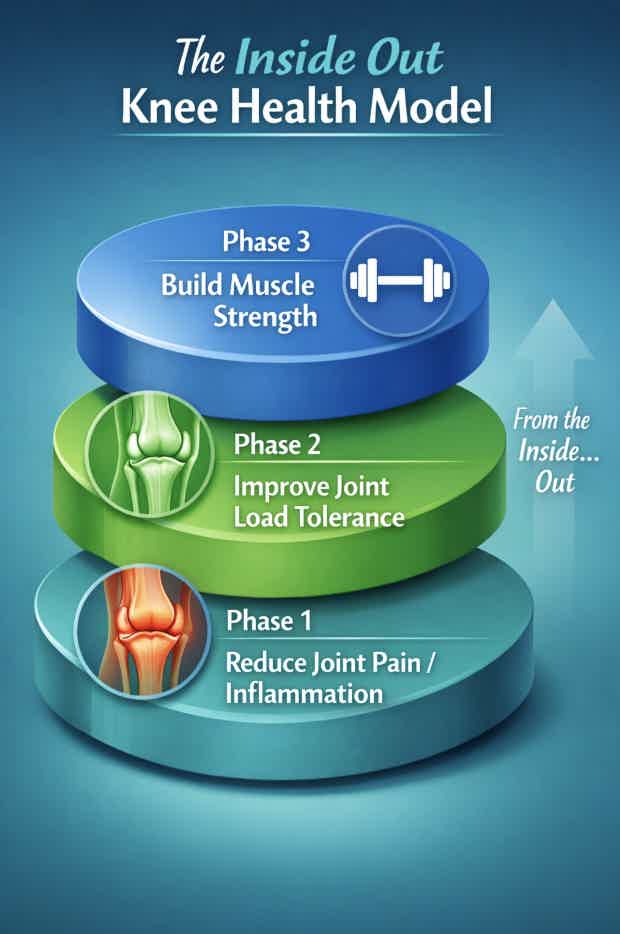
The Inside Out Knee Health approach treats preparing for a trip like Adria's as three distinct phases, not one blanket instruction to "push through" or "rest completely."
Phase 1: Improve synovial fluid quality and reduce irritation.
Before a demanding trip, or immediately after one, the priority is calming the internal joint environment so it isn't working from a deficit before the next demand arrives.
Phase 2: Improve cartilage and Squat Load Tolerance.
Between trips, or between demanding weeks, this is where the actual capacity gets built through progressive, measured loading and tracking exactly how much bodyweight the knee can currently handle in a squat pattern.
Phase 3: Strengthen external structures and return to functional activity.
This is the phase where walking the twenty-minute walks, standing the full concert, or taking the stairs stops requiring a decision at all.
Adria is currently working through Phase 1 and 2.
Her family member has never left what feels like a permanent Phase 3 attempt, without the internal capacity to support it.
What This Looks Like in Practice
This isn't about avoiding travel, or avoiding activity in general.
It's about sequencing the decision correctly.
Before a trip:
If you know a trip involves more walking or standing than your current routine, treat the weeks or months beforehand like training, not just anticipation.
During a trip:
Choosing the rideshare over the twenty-minute walk, or the elevator over the stairs, isn't a rule you follow forever.
It's a temporary decision that protects the joint environment while you're away from your regular strengthening routine and recovery isn't as controllable.
In addition, I’ve written about ways to prevent knee symptoms on long flights.
After a trip:
A day or two of noticeable stiffness or soreness after heavy travel isn't a sign that something is irreversibly wrong.
It's a signal that the demand exceeded current tolerance, which is useful information, not an indication that your knee will always react this way.
Two Mistakes That Undo This Strategy
Mistake 1: Treating Every Modification as Permanent
The person who takes the elevator once and decides they "can't do stairs anymore" has turned a temporary strategy into a permanent identity. The point of Phase 1 and Phase 2 work is to make the modification unnecessary over time, not to make it a new rule for life.
Mistake 2: Confusing Activity Volume With Knee Health
More walking, more steps, more standing is not automatically better for a knee that hasn't built the capacity to tolerate it yet. Adria's family member logs more daily steps than she does. His knees are not better for it. Volume without matched capacity is simply repeated overload.
The Reframe
Most advice about staying active with knee pain assumes that doing less of something is a step backward.
It isn't, when the "less" is temporary and strategic.
The person who takes the Uber isn't choosing to be less active.
They're choosing to spend their knee's current capacity on the parts of the trip that matter most to them, like the concert, the museum, and the walk along the water.
Instead of spending it on the parts that don't, the extra walking to save on a rideshare fare.
Avoidance driven by fear looks identical to avoidance driven by strategy from the outside.
The difference is entirely in whether there's a plan in place to rebuild knee capacity.
Frequently Asked Questions
Is it bad for my knees to take the elevator or a rideshare instead of walking?
No, not when it's temporary and tied to a plan to rebuild your knee's Load Tolerance. Research on tailored activity pacing in adults with knee osteoarthritis found that adjusting activity demands to current capacity improved self-reported joint stiffness over time, compared to a generic, unmodified approach.
How do I know if I'm avoiding activity out of fear versus using it as a strategy?
Ask whether the modification is connected to anything. If you're taking the elevator with no plan to ever build back to stairs, that may be fear-driven avoidance. If you're taking the elevator while actively working on improving your Squat Load Tolerance, it's a temporary strategy with an endpoint.
Why do my knees hurt more the day after travel than during it?
This is a delayed response pattern common with joint irritation. The internal joint environment, particularly synovial fluid quality, doesn't always signal overload in real time. Symptoms like stiffness or swelling often surface hours or a day later, once the joint has had time to react to a demand that exceeded its current tolerance.
My family member insists that walking everywhere keeps him strong. Is he wrong?
Not entirely; movement matters. But volume of activity and Knee Joint Strength are not the same thing. Someone can walk daily for years without ever building the internal capacity that makes that walking pain-free, especially if the knee's Load Tolerance hasn't been directly addressed.
What's the difference between the elevator strategy and just being sedentary?
A sedentary pattern avoids activity broadly and indefinitely. This strategy targets specific high-demand activities temporarily, while other movement and rehabilitation work continues. The goal is always a return to full activity, not a permanent reduction.
Can I use a Variable Incline Plane (VIP) to prepare for a trip in advance?
Yes. Because the VIP measures the percentage of bodyweight your knee can squat without pain, it's an effective way to track whether your Squat Load Tolerance is improving in the weeks leading up to a trip that will demand more from your knees than your regular routine does.
How long does it typically take to rebuild Squat Load Tolerance after a demanding trip?
This varies by individual and is best tracked with measurement rather than assumed on a timeline. Many clients notice their knees improving before they feel a dramatic difference day to day, which is exactly why tracking Squat Load Tolerance closes that gap between what's happening internally and what's felt.
Related Articles
Why Your Knees Hurt on Stairs but Not When You Walk: What Actually Helps
Why Knee Pain Shows Up After Exercise (even when it feels fine at the time)
Why Your Knee Hurts the Day After Hiking (and what it actually means)
What Is Load Tolerance? The Missing Link in Solving Knee Pain
The Inside Out Knee Health Approach: A Smarter Way to Build Stronger Knees
Why Your Knees Feel Stiff After A Long Flight and 3 Simple Ways to Prevent it
Research References
Schepens SL, Braun ME, Murphy SL. Effect of tailored activity pacing on self-perceived joint stiffness in adults with knee or hip osteoarthritis. Am J Occup Ther. 2012 May-Jun;66(3):363-7.
Disclaimer: Disclaimer: The information in this blog post is for educational and informational purposes only and is not intended as medical advice. It should not be used to diagnose, treat, or prevent any health issue or disease without consulting with a qualified healthcare professional. The author of this blog and the website do not bear any responsibility for any actions taken based on the information provided in this blog.
Related Posts

Why Your Knee Feels Puffier Some Days Than Others (And How to Track It)
Some knee swelling isn’t random—it’s a delayed joint response. Learn why your knee looks puffier some days and how to track it with simple measurements.
Why Your Knee Can Get Stronger Before You Feel It
A real client’s knee strength improved from 5 pain-free reps to 14 in 13 days—even though she barely felt a change.

What Healthline Gets Right About Knee Arthritis — And Where the Advice Falls Short
A closer look at Healthline’s knee arthritis advice—what’s helpful, what’s oversimplified, and what you may need instead.