
If you’ve ever stood up after a long flight and noticed that your knees feel stiff or achy, you’re not alone.
Many people report that their knees feel fine while sitting on the plane.
But when they stand up after landing, their first few steps feel tight, awkward, or uncomfortable.
This type of knee stiffness is common after long periods of sitting, whether during air travel, long car rides, or extended desk work.
The reason often has less to do with muscle tightness — and more to do with what is happening inside the knee joint itself.
Why Knees Often Feel Stiff After Sitting on a Plane
When your knee remains in one position for an extended period of time, the surfaces inside the joint experience static pressure.
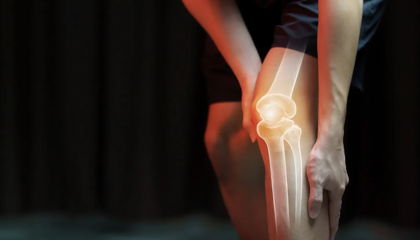
Healthy knees contain synovial fluid, a thick fluid that lubricates the joint (pictured below in light yellow) and helps the surfaces inside the knee move smoothly.

When the knee stays still for long periods, that fluid does not circulate and may not keep the knee comfortable.
As a result, the joint can feel temporarily stiff or sticky when you first stand up.
For many people, this stiffness resolves after a few steps as movement helps redistribute fluid inside the knee joint.
Other Times Your Knees May Feel Stiff After Sitting
The same type of knee stiffness that people notice after a flight can also happen in other situations where the knee remains bent for an extended period of time.
For example, many people notice their knees feel stiff when they:
- Stand up after a long car ride
- Get up after sitting at a desk for several hours
- Stand up after watching a movie or sporting event
- Get out of bed in the morning
- Stand up after sitting on the couch
In most cases, the stiffness improves within a few steps as the knee begins moving again and fluid inside the joint redistributes.
If this happens occasionally, it’s usually not a major concern.
But if knee stiffness happens frequently — or becomes painful — it may indicate that the joint would benefit from improving its internal Load Tolerance and joint environment.
3 Simple Ways to Keep Your Knees Comfortable During Air Travel
Fortunately, a few small adjustments during your flight can help maintain movement inside the knee and reduce stiffness when you stand up.
1. Choose an Aisle Seat (Or Keep the Space Under the Seat Clear)
When your knee stays bent for a long period of time, the joint surfaces remain compressed.
If fluid stagnates inside the knee, you may notice stiffness when you stand up.
Your knee may not straighten easily, and the first few steps may feel uncomfortable.
Changing the position of your knee periodically helps prevent this.
Simple strategies include:
- Straightening and bending your knee a few times every 20 minutes
- Standing up and walking briefly down the aisle once every hour
Choosing an aisle seat makes this much easier because you won’t need to ask other passengers to move.
2. Use Your Ankle to Improve the Quality of Your Knee Fluid
Healthy knees contain synovial fluid that acts like a natural lubricant.
When that fluid is thick and viscous — somewhat similar to egg whites — it helps separate the surfaces inside the joint and prevents stiffness.
One way to encourage quality fluid inside the knee is by gently activating the muscles on the front of the thigh.
You can do this with a simple movement:
- Position your knee so it is almost straight.
- Rest your heel on the floor in front of you.
- Maintain light pressure between your heel and the floor.
- Bend your ankle so your toes move toward your body.
- Hold for 5 seconds.
- Relax.
- Repeat this five times every 30–60 minutes during your flight.
Although the movement occurs at the ankle, it creates a subtle co-contraction in the quadriceps muscles.
This type of isometric quadriceps exercise supports healthy synovial fluid inside the knees, reducing pain and stiffness.

3. Pack a Furniture Mover in Your Carry-On
A furniture mover for carpet can fit easily inside a backpack or carry-on bag.
Once seated on the plane:
- Place the furniture mover on the floor (plastic side down).
- Rest your foot on top of it.
- Gently slide your foot forward and backward.
This allows your knee to bend and straighten comfortably while remaining seated.
If doing this feels good or neutral, repeat it several times (or for a few minutes) while you're reading, listening to music, or chatting with your travel companion.
A Simple Tool That Makes Knee Movement Easier on a Plane
This gentle movement helps distribute fluid throughout the joint and prevents stiffness that can develop during prolonged sitting.
I often recommend this strategy to clients who travel frequently, and many are surprised how much difference a few small movements can make.

I frequently compare knee discomfort to a bank account that’s in debt.
Getting out of debt doesn’t happen instantly — but you can make small deposits.
Brief, periodic knee movement stimulates the joint environment, including the production of hyaluronic acid, one of the key ingredients of healthy joint fluid and a primary component of many knee gel injections.
One deposit may not seem life-changing at first.
But multiple deposits add up.
And as your knee “balance” grows, your knee often begins to feel better and better.
Most people only notice their knees when the balance is negative.
But small, consistent deposits gradually restore the account.
Is Knee Stiffness After Sitting Caused by Tight Muscles?
Many people assume that knee stiffness after sitting is caused by tight muscles.
In reality, the sensation often originates inside the knee joint itself, particularly when the fluid that lubricates the joint has not been moving.
This is why gentle motion — even small movements — can reduce stiffness quickly.
The Real Reason Sitting Can Make Your Knees Feel Stiff
When the knee remains still for extended periods, the fluid that lubricates the joint may not circulate as effectively.
This can create the temporary stiff sensation many people feel when they first stand up.
Encouraging small movements during sitting — even gentle ones — helps maintain a healthier joint environment.
This concept is part of what I describe in my Inside Out Knee Health approach, which focuses on improving conditions inside the knee joint before progressing to more demanding strengthening exercises.

When Knee Stiffness After Sitting Becomes More Persistent
Occasional stiffness after sitting is common.
But if your knees frequently feel stiff, achy, or sore after sitting, it may be a sign that the joint’s Load Tolerance needs to be improved.
Load Tolerance refers to how much force your knee can handle comfortably during movement.
Improving this capacity typically involves gradually strengthening the structures inside and around the joint.
Want to Learn More?
If sitting causes knee stiffness for you — whether on a plane, in the car, or at your desk — you may find this video helpful: The Solution to Sitting Knee Pain. (Watch here.)
Frequently Asked Questions
Why do my knees hurt after flying?
Knees may feel stiff after flying because the joint remains in one position for an extended period of time. Limited movement can reduce circulation of synovial fluid inside the joint, which may lead to temporary stiffness when standing up.
Is knee stiffness after sitting normal?
Yes. Many people experience temporary knee stiffness after sitting for long periods. This often improves within a few steps as the joint begins moving again.
How can I prevent knee stiffness during long flights?
Standing periodically, gently bending and straightening the knee, and performing small activation exercises during the flight can help maintain joint lubrication and reduce stiffness.
Is walking during a flight helpful for knee pain?
Yes. Standing and walking occasionally can help reduce stiffness by encouraging movement inside the knee joint.
Related Articles
- Is Your Knee Pain a Sign of Low Load Tolerance?
- Ice or Heat for Knee Pain? The Answer Most People Never Hear
- Why Rest Isn’t Fixing Your Knees (And What Actually Helps)
- Why Stronger Leg Muscles Don’t Always Mean Better Knees
- How to Make Painful, Sensitive Knees Stronger
- Do Gel Injections Eliminate Knee Pain?
- What Is Load Tolerance? The Missing Link in Solving Knee Pain
Research References
The following research supports the concepts discussed in this article:
- Marian M, Shah R, Gashi B, Zhang S, Bhavnani K, Wartzack S, Rosenkranz A. Exploring the lubrication mechanisms of synovial fluids for joint longevity - A perspective. Colloids Surf B Biointerfaces. 2021 Oct;206:111926. doi: 10.1016/j.colsurfb.2021.111926. Epub 2021 Jun 16. PMID: 34153619.
- Miyaguchi M, Kobayashi A, Kadoya Y, Ohashi H, Yamano Y, Takaoka K. Biochemical change in joint fluid after isometric quadriceps exercise for patients with osteoarthritis of the knee. Osteoarthritis Cartilage. 2003 Apr;11(4):252-9. doi: 10.1016/s1063-4584(02)00372-2. Erratum in: Osteoarthritis Cartilage. 2003 Jul;11(7):548. PMID: 12681951.
- Blewis ME, Nugent-Derfus GE, Schmidt TA, Schumacher BL, Sah RL. A model of synovial fluid lubricant composition in normal and injured joints. Eur Cell Mater. 2007 Mar 6;13:26-39. doi: 10.22203/ecm.v013a03. PMID: 17340555.
- Hui AY, McCarty WJ, Masuda K, Firestein GS, Sah RL. A systems biology approach to synovial joint lubrication in health, injury, and disease. Wiley Interdiscip Rev Syst Biol Med. 2012 Jan-Feb;4(1):15-37. doi: 10.1002/wsbm.157. Epub 2011 Aug 8. PMID: 21826801; PMCID: PMC3593048.
- Jahn S, Seror J, Klein J. Lubrication of Articular Cartilage. Annu Rev Biomed Eng. 2016 Jul 11;18:235-58. doi: 10.1146/annurev-bioeng-081514-123305. PMID: 27420572.
- Clough G. Bend those knees! J Physiol. 2008 Mar 15;586(6):1462. doi: 10.1113/jphysiol.2008.151464. PMID: 18344225; PMCID: PMC2375689.
Disclaimer: Disclaimer: The information in this blog post is for educational and informational purposes only and is not intended as medical advice. It should not be used to diagnose, treat, or prevent any health issue or disease without consulting with a qualified healthcare professional. The author of this blog and the website do not bear any responsibility for any actions taken based on the information provided in this blog.
Related Posts

"You Can't Make Your Knee Any Worse": Why That Common Surgical Advice Isn't Accurate
Common knee surgery advice can overstate risk. Learn why “you can’t make it worse” is an oversimplification—and what helps sensitive knees.

My Shoulder Hurt for Months — Then I Did a Pull-Up. Here's What That Has to Do With Your Knees.
The body often adapts before symptoms improve, which is why people quit their recovery too early. Tracking objective measurements like knee joint Load Tolerance helps bridge the gap between what you feel and what is actually changing. This is the foundation of the Insid
PRP for Knee Pain: An Honest Look at the Evidence
PRP (Platelet-Rich Plasma) injections are among the most debated treatments for knee osteoarthritis. Research suggests PRP can reduce pain and improve function — but platelet dose, preparation protocol, and patient selection significantly affect outcomes. Most important