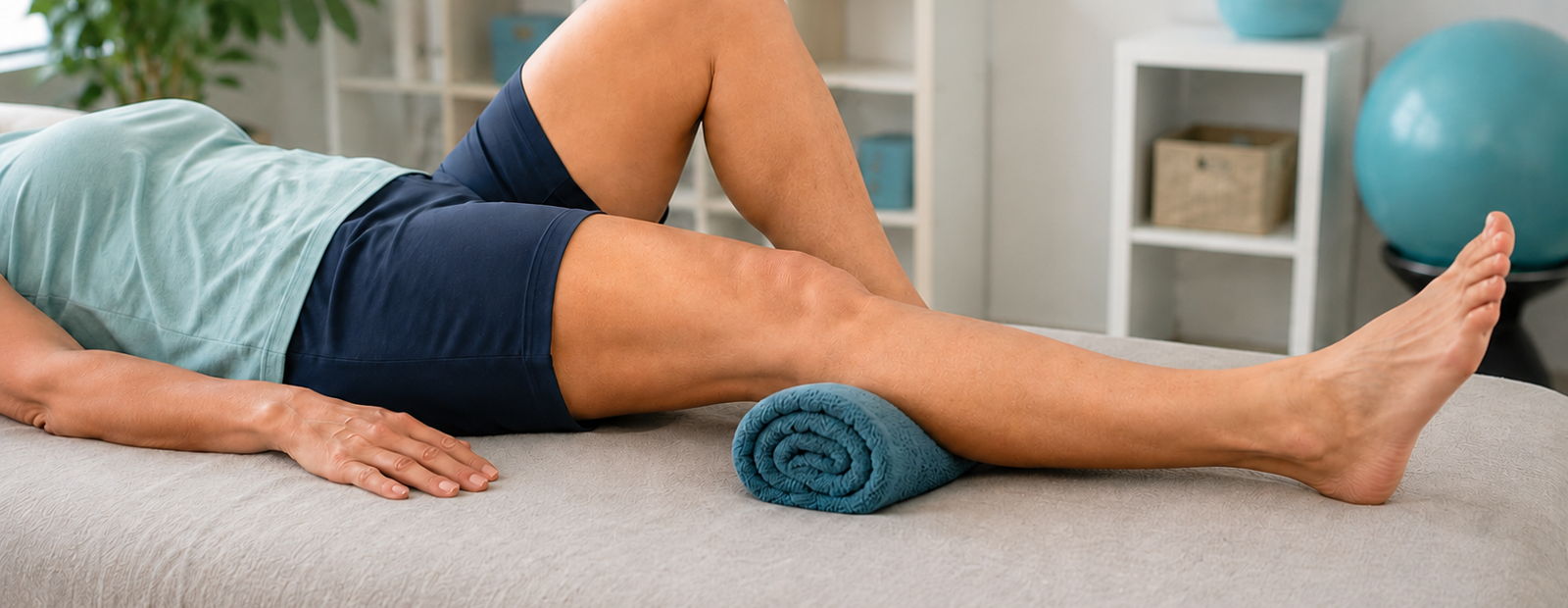
A PT, a Quad Set, and a Cue That Backfired
Julia (a pseudonym) has been doing Quad Sets every day for several weeks, working up toward 80 to 100 repetitions spread across her day, starting before she even gets out of bed.
Last week, her physical therapist watched her do one and offered a correction: push your knee down, drive toward full extension, get more out of the contraction.
Julia told him she used to do exactly that, and it made her knees sore afterward.
Since switching to a gentler cue, just tightening the quad without forcing the end range, the soreness stopped and her quads visibly toned up.
Her physical therapist hadn't expected that. Most people haven't, because most of what gets taught about Quad Sets treats them like a muscle-building exercise. They aren't.
The Mechanism: Why Quad Sets Aren't About Muscle Fatigue
A healthy quadriceps will not fatigue from a Quad Set.
Twelve repetitions won't do it. Eighty won't either.
If you're judging whether a Quad Set is "working" by how hard it feels, you're applying the wrong standard to the wrong tool.
What a Quad Set actually changes is the environment inside the joint, not the size or endurance of the muscle around it.
Gently and repeatedly tightening the muscles on the front of the thigh, the quadriceps, without pushing into an aggravating end range, helps circulate and thicken the synovial fluid that lubricates and nourishes the structures inside your knee.
Cartilage itself has no nerve supply, so it cannot directly signal pain.
But the tissues around it, including the synovial membrane, respond to irritation with swelling.
And swelling changes how your nervous system treats your own muscle.
This is called arthrogenic muscle inhibition.
When a knee joint is swollen or irritated, the nervous system reflexively reduces how much it will activate the surrounding quadriceps, even when the muscle itself is fully capable of contracting harder.
Research on knee osteoarthritis has documented this same pattern for years: quadriceps weakness in an arthritic knee is frequently an inhibition problem, not a true strength deficit.
Think of it like a dimmer switch instead of an on/off light switch.
You can still turn the muscle on.
But an irritated joint won't let you turn the muscles up past a certain point, no matter how hard you try.
Quad sets, done correctly, are one of the most direct ways to turn that dimmer back up, not by making the muscle stronger, but by calming the joint enough that the muscle is finally allowed to work at its real capacity.
For Inside Out Knee Health,
here's a guide to get started:
You can access it here.
How This Fits Into Inside Out Knee Health
This mechanism is the entire logic behind Phase 1 of Inside Out Knee Health.
Phase 1: Improve the internal joint environment.
Quad sets, along with other low-load motion, reduce irritation and support synovial fluid quality before any real loading begins. This is where Julia has spent her recent months of daily practice.
Phase 2: Build measurable Squat Load Tolerance.
Once the joint environment has calmed down, we begin measuring exactly how much pain-free load a knee can handle in a squat rather than guessing.
Phase 3: Return to functional, real-life activity.
For Julia, that means an upcoming multi-day international hiking trip.
The goal of Phase 1 work isn't to do Quad Sets forever. It's to build a joint environment stable enough to support the loading in Phase 2, so a knee is genuinely ready for Phase 3.
This same sequence is visible in another client's numbers, where pain-free squat repetitions nearly tripled in under two weeks, not because her muscles suddenly got stronger, but because the internal joint environment finally allowed her existing strength to show up.
What This Looks Like in Practice
Julia's routine isn't complicated, but the details matter.
She performs her Quad Sets before getting out of bed each morning, working toward 80 to 100 total repetitions across the day at roughly 5-second holds.
On mornings she skips this, she notices her knee feels worse before she's even out the door, immediate feedback on how much this Phase 1 work is doing.
Her cue is a simple quad flex, without driving into terminal knee extension.
She also engages her core and glutes during the hold, which supports better overall control of the joint rather than isolating the quadriceps alone.
This isn't a generic exercise handed out on a photocopied sheet.
It's dosed, cued, and tracked against how Julia's specific knee responds.
Common Mistakes People Make With Quad Sets
Mistake 1: Cueing terminal knee extension before the joint is ready
Pushing hard into full straightening is a common cue, and it isn't wrong for every knee. But for a knee that's still irritated or swollen, forcing that end range can reintroduce the very irritation you're trying to resolve. The limiting factor often isn't a lack of muscle effort. It's a joint that isn't ready to be pushed that far yet.
Mistake 2: Judging the exercise by how hard it feels
Because quad sets don't fatigue muscle, an easy-feeling set is not a failed set. Consistency and volume matter more than intensity here. Expecting a burn is a sign of applying muscle-building logic to a joint-calming exercise.
Mistake 3: Dropping the routine while traveling
It's tempting to let daily drills lapse during travel or a busy stretch. But this Phase 1 work is exactly what tends to be most portable, doable in a plane seat, a hotel room, or before getting out of bed, and skipping it is often when knees feel worse.
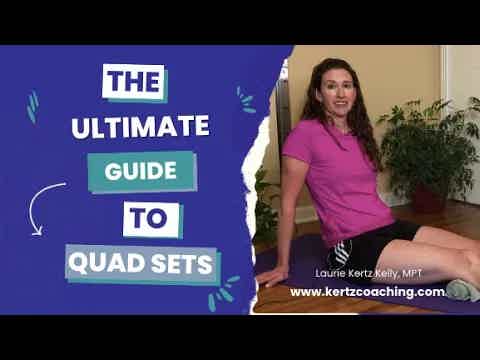
(Watch the full video here.)
The Reframe: Easy Isn't the Same as Ineffective
Fitness culture trains people to equate effort with results.
If it doesn't burn or if it doesn’t feel hard to do, it must not be working.
That instinct is exactly backwards for a Quad Set. The goal was never to make you sweat.
It was to reduce the swelling and irritation that were quietly limiting your quad the whole time.
X-rays and imaging findings don't reliably predict how much pain or function someone has, which is part of why an exercise this gentle can still produce a visibly stronger, better-functioning knee.
The joint environment, not the picture on a scan, is what determines how your muscle is allowed to perform.
FAQ
What exactly is a Quad Set?
A quad set is a static (isometric) contraction of the muscles on the front of the thigh (quadriceps), typically performed lying or sitting with the knee gently supported, without moving the joint through a range of motion. It's often the first exercise introduced after knee injury or irritation, and it improves the quality of the synovial fluid inside the knee.
H3: Why don't Quad Sets tire out my legs?
Because a healthy quadriceps needs far more resistance or repetition than a Quad Set provides to reach true muscular fatigue. The exercise isn't dosed to build endurance strength; it's dosed to circulate synovial fluid and reduce joint irritation.
Should I push my knee down to get a better contraction?
Not necessarily, and for an irritated knee, this can backfire. Pushing toward terminal knee extension isn't required during a Quad Set, and for some knees it reintroduces the swelling that's suppressing muscle activation in the first place.
Why does a swollen knee make my muscles feel weaker, even if I've been strength training?
Knee joint swelling triggers a reflexive drop in how much the nervous system will activate the surrounding quadriceps, a phenomenon called arthrogenic muscle inhibition. This has been observed repeatedly in knee osteoarthritis populations specifically, where quadriceps weakness often tracks with joint irritation rather than a true loss of muscle capacity. Strength training the muscle harder doesn't fix an inhibition problem.
How many Quad Sets should I be doing, and how often?
This varies by individual, but many clients work toward 80 to 100 pain-free repetitions spread across a day, often in short sets of 10 to 20 with brief 5-second holds, rather than one long session. Frequency and consistency across the day tend to matter more than any single session's intensity.
Is it okay to skip Quad Sets while traveling?
If a full routine isn't possible, prioritizing the daily, low-load pieces, Quad Sets included, over more demanding strength work is usually the better trade-off. This is a single case observation, not a guaranteed outcome for every knee, but many clients notice their knee feels worse on days this baseline work gets skipped.
If Quad Sets don't build muscle, why do my quads look more defined after consistently doing them?
Muscle tone and visible definition can improve when a previously inhibited muscle is finally allowed to activate more fully, not necessarily because the muscle has grown larger. As joint irritation and swelling decrease, the dimmer-switch effect of arthrogenic muscle inhibition lifts, and muscles that were already strong simply become able to show it.
Related Articles
Why Knee Pain Shows Up After Exercise (even when it feels fine at the time)
Why Your Knee Can Get Stronger Before You Feel It
Why Your Knee Feels Stiff After a Long Flight (And 3 Simple Ways to Prevent It)
The Best Investment for Knee Pain
What is Load Tolerance? The Missing Link in Solving Knee Pain
How to Use What Navy Seals Know to Overcome Knee Pain
Can You Actually Build Cartilage Strength? What the Research Says
Video Reference
“The Ultimate Guide to Quad Sets,” Laurie Kertz Kelly, Better Knees (YouTube), May 6, 2020.
Research References
Miyaguchi M, Kobayashi A, Kadoya Y, Ohashi H, Yamano Y, Takaoka K. Biochemical change in joint fluid after isometric quadriceps exercise for patients with osteoarthritis of the knee. Osteoarthritis Cartilage. 2003 Apr;11(4):252-9. doi: 10.1016/s1063-4584(02)00372-2. Erratum in: Osteoarthritis Cartilage. 2003 Jul;11(7):548. https://pubmed.ncbi.nlm.nih.gov/12681951/
Norte G, Rush J, Sherman D. Arthrogenic Muscle Inhibition: Best Evidence, Mechanisms, and Theory for Treating the Unseen in Clinical Rehabilitation. J Sport Rehabil. 2021 Dec 9;31(6):717-735. https://pubmed.ncbi.nlm.nih.gov/34883466/
Sophia Fox AJ, Bedi A, Rodeo SA. The basic science of articular cartilage: structure, composition, and function. Sports Health. 2009 Nov;1(6):461-8. https://pmc.ncbi.nlm.nih.gov/articles/PMC3445147/
Torry MR, Decker MJ, Millett PJ, Steadman JR, Sterett WI. The effects of knee joint effusion on quadriceps electromyography during jogging. J Sports Sci Med. 2005 Mar 1;4(1):1-8. https://pmc.ncbi.nlm.nih.gov/articles/PMC3880079/
O'Reilly SC, Jones A, Muir KR, Doherty M. Quadriceps weakness in knee osteoarthritis: the effect on pain and disability. Ann Rheum Dis. 1998 Oct;57(10):588-94. https://ncbi.nlm.nih.gov/pmc/articles/PMC1752483
Centers for Disease Control and Prevention. Osteoarthritis. Atlanta (GA): CDC; 2024 Jan 26. https://www.cdc.gov/arthritis/osteoarthritis/index.html
Disclaimer: Disclaimer: The information in this blog post is for educational and informational purposes only and is not intended as medical advice. It should not be used to diagnose, treat, or prevent any health issue or disease without consulting with a qualified healthcare professional. The author of this blog and the website do not bear any responsibility for any actions taken based on the information provided in this blog.
Related Posts

Why Taking the Uber Instead of Walking Might Be the Smartest Thing You Do for Your Knees
More walking isn’t always better for sore knees. Learn when taking the Uber, choosing the elevator, or pacing a trip can protect knee load tolerance.

Why Your Knee Feels Puffier Some Days Than Others (And How to Track It)
Some knee swelling isn’t random—it’s a delayed joint response. Learn why your knee looks puffier some days and how to track it with simple measurements.

"You Can't Make Your Knee Any Worse": Why That Common Surgical Advice Isn't Accurate
Common knee surgery advice can overstate risk. Learn why “you can’t make it worse” is an oversimplification—and what helps sensitive knees.