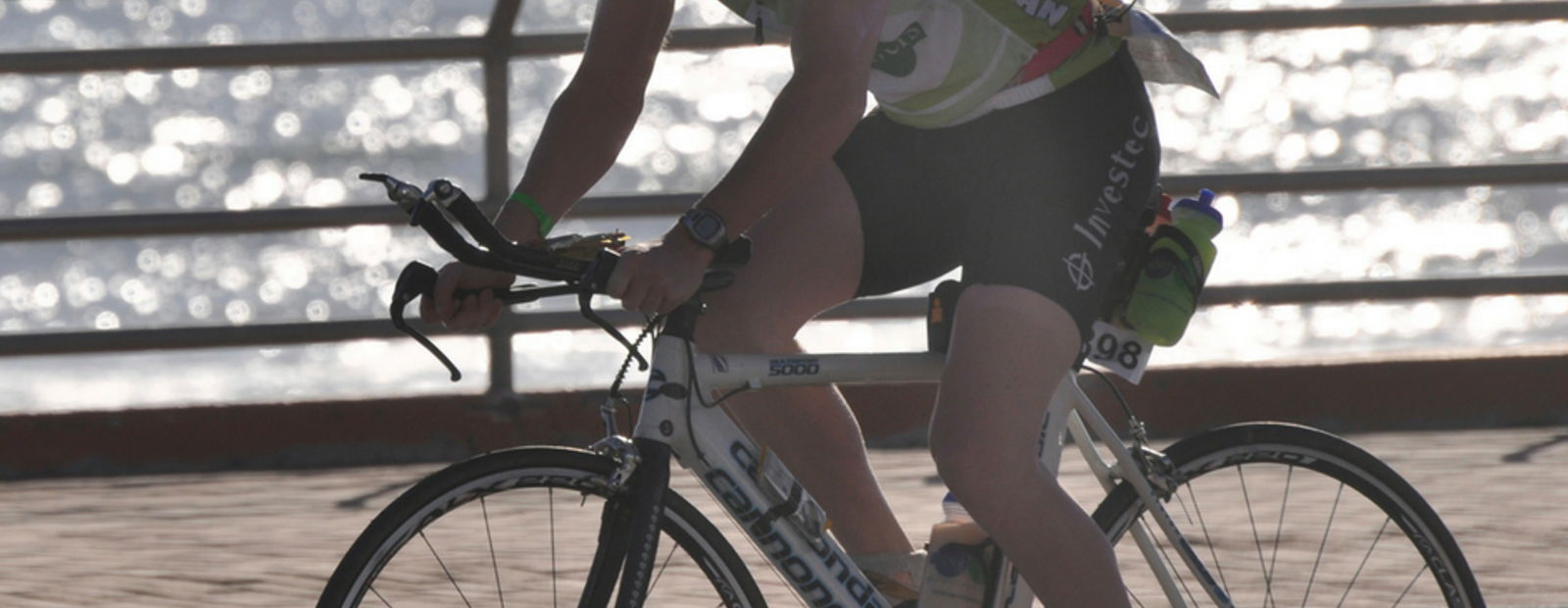
Knee stiffness ranges from annoying to problematic to debilitating. Some people notice it immediately upon getting out of bed in the morning. Other people notice it after they've been sitting for a long time in a car or at a desk.
Moving your knees while cycling, swimming, or practicing yoga decreases stiffness.
But if you're looking for a solution that costs less time, less effort, and less money, this video describes a convenient option:
This simple exercise is easy to perform at a desk, on a plane, or while texting.
For more information on safely strengthening your knees, read How to Grow Strong Knee Joints and Can You Rebuild Knee Cartilage?
For a step-by-step plan to eliminate your knee stiffness or pain-- a program customized specifically for you-- work with me. To learn if working together is a good fit for you, scheduled a Strategy Session, by clicking here.
As I was cleaning out my closet, I found something from roughly 18 years ago.
A cycling jersey.
(It’s pictured below.)
But I’ve never been a competitive cyclist.
When I moved to Austin almost two decades ago, I was looking to meet people in my new city.
So I attended a Saturday cycling workshop.
We learned bike maintenance, and then we went on a hilly group ride.
I had such a great time!
But the following day, I had burning, achy pain on the front of my knees.
And it didn’t just go away on its own.
At the time, I was struck by how something that I was told in physical therapy school – that biking is good for your knees – had somehow caused my painful knees.
What was going on?
When I stopped to think about the people whom I had helped in my initial years as a physical therapist, I recognized that:
- Some of them reported that biking made their knees feel better.
- But others who rode a stationary bike for several minutes in the clinic reported that their knees felt worse.
- And sometimes they didn’t feel this increase in knee pain until the next day.
Fast forward to today:
My knees feel great.
I enjoy rigorous hikes, weight lifting, yoga, pickleball, and yes, even hilly bike rides!
And I’m frequently asked this question:

Will biking make your knees stronger?
When you’re biking, you’re using your leg muscles.
The muscles on the front of your thighs (your quadriceps) straighten your knees.
Your quadriceps start from the front of your hip and the upper part of your thigh bone.
And they attach onto your shin bone, via the patellar tendon / ligament, pictured here:

The hamstring muscles, on the back of your thighs, bend your knees.
Your hamstrings (highlighted in teal, below) start from the bones that you sit on (ischial tuberosities) and attach on the back of your shin bones (tibia and fibula).

When your quadriceps or your hamstring muscles contract, they pull your shin and thigh bones together, and this "squishes" everything in between your bones.
This includes both the cartilage on the ends of your bones (labelled below as “articular cartilage”) and the synovial fluid (pictured below in yellow).

When it’s strong, your cartilage is a firm substance.
And when it’s healthy, your synovial fluid is thick.
Stronger, healthier knees – your cartilage and your synovial fluid – are able to withstand more force (more "squishing") without pain.
If your knees are not strong and healthy enough to withstand the forces from your activities, your knees will likely become sore, achy, stiff, or swollen.
4 ways that force affects your knees
> If you don’t place enough force on your knees, your knees will weaken.
This occurs when someone is more sedentary for a season or an extended period of time.
> If you place too much force on your knees, your knees will weaken.
Force that exceeds what your knees can withstand occur with:
- high force applied quickly (during a single impact, such as a fall or a car accident),
- low force applied over a longer period of time (staying in a certain position, like sitting or standing), or
- repetitive forces (movements, including hiking, running, squatting, biking, and pickleball).
> If you place the right amount of force on your knees – not too little and not too much – you’ll maintain your knee strength.
This means, if you're experiencing either constant or periodic knee pain, those sore, achy, stiff, sharp, or swollen sensations don't go away.
> And if you start with the right amount of force on your knees, and then gradually place more and more force on your knees, your knees will get stronger.
The 5 step process to strengthen your knees with a bike:
Step 1. Identify your biking tolerance.
This involves determining the type, duration, and intensity of biking that feels good or neutral for your knees.
- The type of biking you choose may be a stationary bike, a road bike, or a mountain bike.
- The duration refers to how long you ride your bike.
- The intensity of biking is determined by factors including how fast you pedal and the resistance you’re using. (Resistance may be set on a stationary bike. On a road/mountain bike, the resistance will depend on elevation changes and on the gears you choose.)
If you get knee pain, stiffness, or swelling during or after biking, you have exceeded your knees’ tolerance for biking.
Allow those symptoms to resolve before your next bike ride.
(If you’d like some additional guidance with this step, watch this video.)
Step 2. Establish your biking baseline.
Using the type, duration, and intensity that you identified in step one, ride your bike 3 times per week on non-consecutive days.
Repeat this during a second week.
IF you experience any knee soreness, stiffness, swelling, or pain, adjust at least one biking variables (the type, duration, and/or intensity of your biking) until you can complete step two without causing knee symptoms.
You’re ready to move on to step three when you have found a type, duration, and intensity of biking that you can perform three times per week for 2 weeks – without causing knee symptoms.
Step 3. Advance your biking.
Option A: Increase your biking duration by roughly 10 - 20%.
Let’s say your baseline for biking was 20 minutes on Tuesday, Thursday, and Saturday.
In this case, advance to 24 minutes on three non-consecutive days the following week.
- IF your knees feel good or neutral during and after these 24-minute rides, continue advancing your biking duration by 10 - 20% in the subsequent week.
- IF you experience knee pain, swelling, or discomfort following these 24-minute rides & these knee symptoms resolve completely within 36 hours, continue with three 24-minute rides the subsequent week.
- IF you experience knee pain, swelling, or discomfort following these 24-minute rides & these knee symptoms persist for longer than 36 hours, do two things: (1) allow your symptoms to resolve before continuing, & (2) drop your duration by at least 10% during the subsequent week. (For example, instead of three 24-minute rides, bike for 21 minutes on three non-consecutive days.)
Option B: Gradually increase the resistance while you’re biking.
So if your baseline for biking was 20 minutes on Tuesday, Thursday, and Saturday, you’ll continue to ride for 20 minutes on three non-consecutive days, and you’ll gradually increase the resistance.
Resistance is measured and adjusted most easily on a stationary bike.
It’s possible to increase resistance while riding a bike outside by starting on a flat road, then one with some rolling hills, and progressing to steeper or more frequent elevation changes.
During the week that you make a small increase in your bike’s resistance:
- IF your knees feel good or neutral, continue advancing the resistance during 20-minute bike rides the subsequent week.
- IF you experience knee pain, swelling, or discomfort & these knee symptoms resolve completely within 36 hours, continue with that same small increase in resistance the following week. (Hold off on increasing the resistance additionally.)
- IF you experience knee pain, swelling, or discomfort & these knee symptoms persist for longer than 36 hours, do two things: (1) allow your symptoms to resolve before continuing, & (2) decrease your resistance during the subsequent week.
Pro Tip: Choose either Option A or Option B – not both.
My clients know this is what I frequently refer to as “limiting the variables.”
If you experience an increase in symptoms after simultaneously making two types of changes, such as increasing duration and resistance, it’s difficult to interpret what your knees are saying.
Are your knees saying they didn’t like how long you biked?
Are your knees saying they didn’t like how hard you biked?
Or are your knees saying that the duration and the resistance were fine, but both increases together were too much?
Having this level of insight gives you greater clarity on how to proceed.
Step 4. After three weeks of advancing your biking, repeat steps one through three.
When you’re able to advance your biking (duration or resistance) during three separate weeks – without experiencing an aggravation in knee symptoms – reassess your bike tolerance (step one).
This involves determining the type, duration, and resistance of biking you can do while your knees feel good or neutral, during and afterwards. (Review how to do this within step one above.)
Using your newly determined bike tolerance, ride your bike 3 times per week on non-consecutive days.
Repeat this during a second week.
When you’re able to complete two weeks of biking three times per week – without causing knee symptoms – you’re ready to move on to step three. (For additional guidance, review step two above.)
Finally, repeat step three (above).
Step 5. When you’ve achieved your desired strength gains, celebrate your results!

Steps to Strengthen Your Knees with a Bike
- Identify your biking tolerance.
- Establish your biking baseline.
- Advance your biking.
- Repeat steps one through three.
- Celebrate your results.
Takeaways:
- When you’re using your quadriceps or hamstrings, these leg muscles pull your thigh bones and shin bones together.
- This “squishes” everything in between – in particular, the cartilage and the synovial fluid in your knees.
- When these parts of your knees aren’t strong enough to withstand the forces from your activities, knee pain, swelling, or stiffness results.
- By placing the right amount of force on your knees and gradually increasing these forces, your knees will get stronger.
- Stronger knees will allow you to be more active without knee pain.
Let's build Better Knees together!

Laurie Kertz Kelly
When you’re ready to build Better Knees –
with personal guidance:
Schedule a free 20-minute Strategy Session. (Find your best time here.)
Disclaimer: The information in this blog post is for educational and informational purposes only and is not intended as medical advice. It should not be used to diagnose, treat, or prevent any health issue or disease without consulting with a qualified healthcare professional. The author of this blog and the website do not bear any responsibility for any actions taken based on the information provided in this blog.
Disclaimer: Disclaimer: The information in this blog post is for educational and informational purposes only and is not intended as medical advice. It should not be used to diagnose, treat, or prevent any health issue or disease without consulting with a qualified healthcare professional. The author of this blog and the website do not bear any responsibility for any actions taken based on the information provided in this blog.
Related Posts

Why Muscle Strengthening Helps Some Knees and Hurts Others
Strengthening helps some knees and irritates others because the key factor is load tolerance—not effort, form, or willpower.

Did knee surgery work for this Wimbledon champion?
Last week I saw Novak Djokovic wearing a compression sleeve on his right knee at Wimbledon. Djokovic has won 24 tennis championships and has been ranked No. 1 in the world during 13 years of his career. It

Do knee gel injections work?
Carol* was recently telling me about her knees.Over the past couple of years, her knees had become "achy."Her knees weren